
Autonomous systems are operating across distributed environments in ways that existing operational and security models are not structured to manage. The challenges they introduce don’t have a straightforward fix. Extending existing monitoring approaches, retrofitting identity frameworks, or adding policy controls to current platforms addresses symptoms without resolving the underlying architectural mismatch. That architectural mismatch is driving interest in a new concept: the Agent Control Plane (ACP).
For security vendors, understanding what the Agent Control Plane is, where it fits within the broader AI stack, and what functions it may provide is becoming increasingly important as autonomous system deployments continue to scale.
This article introduces the concept, examines its core functional components, and explores why contextual intelligence is becoming a critical input into ACP decision making, while acknowledging that the market is still early and implementations are just beginning to take shape.
What an Agent Control Plane Is and Where It Fits
Conceptually, the Agent Control Plane is a governance and operational layer that sits above the execution environment where autonomous agents operate. Understanding what it provides and where it fits requires first examining the AI stack within which it is designed to operate.
At the foundation are the infrastructure and compute layers that power AI workloads. Above those sit the data and model layers, where foundation models are trained and deployed. The orchestration layer connects models to tools, workflows, and external services, enabling agents to execute tasks across applications and APIs. At the top sits the application layer, where end users and autonomous systems interact with AI powered capabilities.
Within that stack, the ACP sits alongside and above the orchestration and application layers rather than functioning as a discrete layer within them. Where an orchestration framework manages how tasks are executed, the ACP governs whether those tasks should be executed, under what conditions, and with what constraints. Orchestration frameworks may include guardrails or telemetry, but they are generally not designed to provide enterprise-wide governance, identity, visibility, and trust management across distributed autonomous ecosystems.
That distinction is important. Orchestration frameworks are built for execution efficiency. The ACP is conceived to provide the governance and control that execution focused frameworks are not designed to deliver. The two are complementary rather than competing. That relationship is foundational to understanding what the ACP could provide and why it is emerging as a concept distinct from the tools and frameworks already in place.
Core Functional Components of an Agent Control Plane
While no standard ACP architecture exists today, several functional components are emerging consistently across early implementations and conceptual frameworks. Understanding these components at a high level provides a clearer picture of what an ACP is designed to do and how its parts work together to provide governance and control across autonomous agent ecosystems.
Traffic Sources
The starting point for any ACP is visibility into what is generating activity across the environment. Traffic sources encompass the full range of autonomous actors and systems that an ACP needs to monitor and manage, including AI agents, applications, APIs, workflows, user and device interactions, and IoT and external services. Identifying what is initiating activity and where it is coming from is the foundational input that every other ACP component depends on.
Reasoning and Decisioning
The reasoning and decisioning component is where the ACP evaluates incoming activity and determines how to respond. This layer typically includes AI models, rules engines, policy logic, and orchestration capabilities that work together to assess context, evaluate risk, and make informed decisions about how autonomous agent activity should be handled. Components within this layer may include context awareness, risk based decisioning, policy management, and continuous learning capabilities that enable the ACP to adapt as autonomous environments evolve.
Policy and Control
The policy and control component translates decisioning outputs into actionable governance. It is where the rules, constraints, and boundaries that govern autonomous agent behavior could be defined and enforced. This includes managing agent identity, validating trust relationships, controlling task execution permissions, and ensuring that autonomous activity stays within defined operational boundaries.
Enforcement
The enforcement component is where ACP decisions are acted upon across the environment. Enforcement outputs typically include actions such as allowing permitted activity, blocking access to unauthorized services, isolating or containing suspicious behavior, logging activity for audit and telemetry purposes, and escalating to human review when autonomous activity exceeds defined thresholds or risk tolerance.
Observability
Observability within an ACP goes beyond traditional monitoring. Rather than simply tracking whether systems are operational, ACP observability is focused on explaining what autonomous agents are doing, why they are doing it, and whether their behavior is consistent with intended outcomes. This includes tracing agent decisions, monitoring workflow execution, and maintaining visibility into the full scope of autonomous activity across distributed environments.
Intelligence
The intelligence component enriches ACP decision making with contextual signals that inform risk assessment and policy enforcement. This includes reputation scoring for domains, IPs, and services that autonomous agents interact with, threat detection capabilities, category and classification data for AI and SaaS applications, and behavioral insights that help the ACP distinguish expected from unexpected autonomous activity.
To illustrate how these components might work together in practice, zvelo has developed a reference design that shows one possible approach to integrating intelligence services into an ACP architecture. The diagram below provides a high level overview of how these components could be organized and how intelligence data flows through the decision making process.
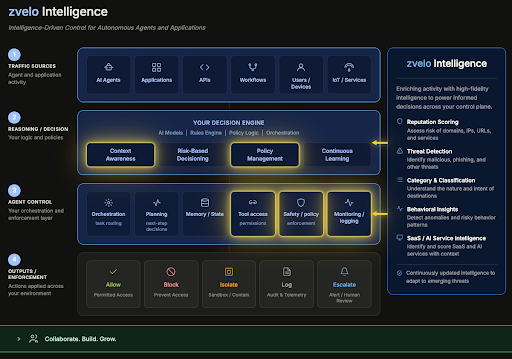
Together, these components illustrate one possible framework for how an ACP could be organized and how information, decisions, and enforcement actions may flow through the architecture. The level of performance depends on context and would be directly related to the quality of intelligence and context flowing through it.
Why Context Matters in Autonomous Decision Making
The functional components of an ACP describe the architecture. Context is what makes that architecture actionable. In human driven environments, a user’s identity, role, and behavioral history provide a baseline that security platforms can reason about. Autonomous agents often do not yet carry the same mature, consistently governed identity, role, and behavioral context that security platforms have built around human users.
They initiate connections, invoke services, and execute workflows based on instructions rather than established identity and behavioral patterns. Without contextual intelligence informing the reasoning and decisioning layer, an ACP can identify that autonomous activity is occurring but lacks the signals needed to evaluate whether that activity represents a risk, falls within policy boundaries, or warrants a response.
Risk scoring, application intelligence, and trust evaluation are among the most important contextual inputs an ACP can consume. Knowing the reputation of the services autonomous agents interact with, understanding what AI and SaaS applications are capable of and how they behave, and evaluating the authorization status of agents involved in an interaction are all foundational to accurate decisioning. Together these contextual inputs help transform the ACP from a policy enforcement mechanism into an intelligence driven decisioning layer that can respond proportionately and accurately as autonomous ecosystems continue to evolve.
The Future of the Agent Control Plane
The Agent Control Plane is still taking shape. No standard architecture exists today, and the implementations that are beginning to emerge reflect a range of approaches rather than a converging consensus. That is expected at this stage. The concept is gaining attention precisely because the challenges autonomous ecosystems introduce are becoming more visible, and the industry is beginning to recognize that addressing them requires a different kind of architectural thinking.
For security vendors, the ACP concept is becoming important for reasons that extend beyond simple awareness. The functional components discussed in this article, traffic sources, reasoning and decisioning, policy and control, enforcement, observability, and intelligence, represent the building blocks of an architectural approach that is still being defined. Vendors who develop a clear understanding of those components and how they work together will be better positioned to contribute to that definition as the market matures.
Upcoming articles will go deeper into each of those layers, examining the security and visibility gaps within them, how intelligence services can support ACP decisioning, and what early implementations are beginning to reveal about where the architecture is heading.